We are looking to fill the Scouting America Jamboree team. Seminary students will get a chance to explore conversations with youth from across America and the world. The opportunity to put the practical conversation into the walk with Christ is a rare opportunity.
This is not a long-term commitment but will have a long-term impact. Consider the options and join us.
There are many ways to serve—whether through preaching, pastoral care, mentoring, listening, or simply being a visible presence of faith and encouragement. The Jamboree is a place where you can learn, grow, share, and connect in powerful ways. If you can’t make it the whole time, just let us know. We can always use your gifts for God.
Interested participants should contact Steven Scheid by January 12, 2026.
When the Associated Press calls, it gives you pause. It’s not just about answering questions—it’s about reflecting on the journey. My conversation with David Cary was honest and thoughtful, touching on the evolving landscape of Scouting America. Yes, there have been challenges. Yes, there have been changes. Some were long overdue; others simply mirrored the shifting realities of youth and society.
Yet through it all, one truth remains: Scouting continues to be a place where people learn to live alongside one another—even when we disagree. That principle is woven into the fabric of the Scout Oath and the Scout Law. It’s not just about camping or badges; it’s about building a community where you can witness others living authentically and feel supported in living your own truth. It’s a place to grow through difference, not in spite of it.
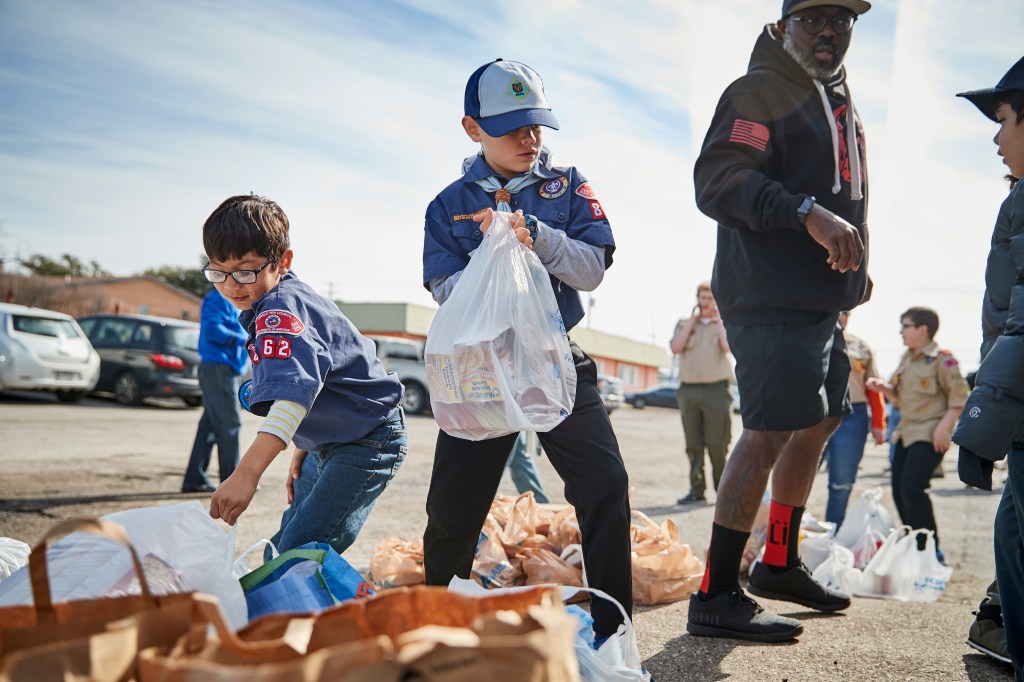
Cub Scouts Serving in the Annual Scouting for Food. Photo courtesy of Scouting America.
Through Scouting, I’ve formed friendships across every faith tradition. Some of the most profound conversations I’ve ever had—where heart meets mind—have come from these relationships. And for those who don’t identify with any faith, Scouting still offers a space to explore, express, and belong. It is an invitation to learn about others and yourself in a whole life context, including the spiritual.
One moment stands out vividly. We were in a meeting when word came that a friend had fallen and broken her kneecap. Instantly, the room shifted. Seated together—Jews, Muslims, Protestants, Catholics, Sikhs, Buddhists, Latter-day Saints, and others—we turned to prayer. In that moment, a Baptist friend in need united a tapestry of faiths in a single, heartfelt plea to God. What would it be like to see the hurt in the world and allow it to bring us together for the healing of all people?
That’s the power of Scouting. It’s not just an organization—it’s a living, breathing example of what it means to be together. To care. To show up. To believe in something bigger than ourselves.
Thank you, David, for asking the questions about faith group support of Scouting. Thank you for helping me to remember the reasons we stand with-and within-Scouting together.
Ecclesiastes chapter 4 has a lot to say about the harshness of life and the advantages of friendship.
“When I next observed all the oppressions that take place under the sun, I saw the tears of the oppressed—and they have no one to comfort them. Their oppressors wield power—but they have no one to comfort them. 2 So I declare that the dead, who have already died, are more fortunate than the living, who are still alive. 3 But happier than both are those who have never existed, who haven’t witnessed the terrible things that happen under the sun.”
When reading Ecclesiastes, we need to remember that it is a work of wisdom literature (Ketuvim). It instructs through proverbs, poetry, and reflection.
The opening of chapter four paints a bleak existence for those who have experienced the oppressions of this world alone. Abuse, particularly sexual abuse, is one of the most harmful of these worldly oppressions.
Survivors of abuse have expressed the depth of despair and hopelessness gathered in the solitude of experience.
There is hope. The solitude of abuse does not have to remain. You can and should be a friend to others. “Love one another as I have loved you” is Christ’s call.
It is also the call of Ecclesiastes. There is wisdom here.
“Two are better than one because they have a good return for their hard work. 10 If either should fall, one can pick up the other. But how miserable are those who fall and don’t have a companion to help them up! 11 Also, if two lie down together, they can stay warm. But how can anyone stay warm alone? 12 Also, one can be overpowered, but two together can put up resistance. A three-ply cord doesn’t easily snap.”
The context of “those who fall” needs to be understood in the context of abuse. No matter what happened or how it happened, the abuse is not your fault.
But there is a need for a companion to help, to change the coldness to warmth, and resist the darkness left in the wake of harm. Are you a friend?
You can help. Our friends and yours at Protect Children are fierce defenders of youth, even if you do not know it. They have never stopped being a light, chasing out the darkness.
Protect Children know that, “when a child is sexually abused, they’re most likely to tell a friend first. All too often, the abuse is never reported – meaning too many children are not getting the help they need.”
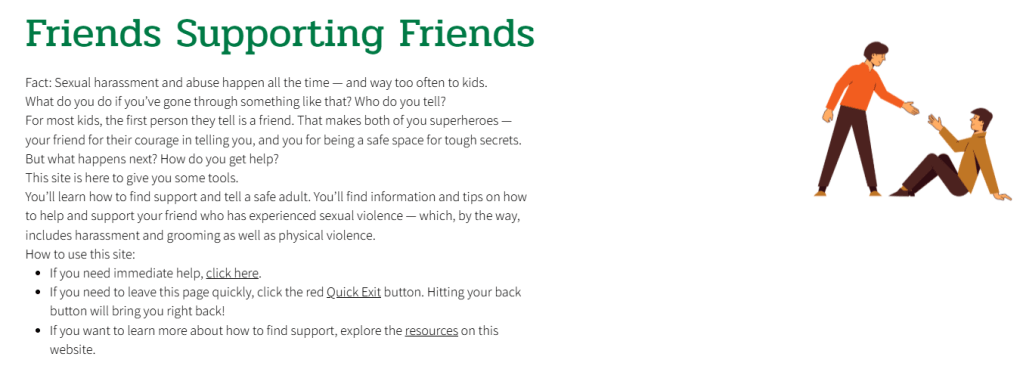
That’s why Protect Children, alongside ChildFund International and 19 other organizations, is launching #MyFriendToo U.S. website this Child Abuse Prevention Month – to help young people help their friends disclose sexual abuse to a safe adult.
The #MyFriendToo U.S. website guides children in helping their friends disclose sexual violence to safe adults and ensures that they receive information about protection and restorative services. The whole website is written in child-friendly language, almost as if a friend or older sibling is there to let them know they’re doing the right thing and to help them or their friend get the resources they need.
The website teaches kids and teens how to respond safely to cases of suspected or confirmed sexual violence, educates children about their rights, and connects them to services.
As an open-ended question, it might seem significant. There are a lot of reasons for not moving forward.
“I just got stuck.”
“The light is still red.”
“I stayed still long enough; my muscles just don’t work the same.”
“It is easier to not move.”
The Mayo Clinic shared that sitting too much leads to terrible consequences.
Extended sitting has been linked to obesity. It also has been linked to a cluster of conditions that make up metabolic syndrome. These conditions include increased blood pressure, high blood sugar, excess body fat around the waist and unhealthy cholesterol levels.
Too much sitting overall also seems to raise the risk of death from heart disease and cancer.
We have all been waiting for the next shoe to drop in our Scouting relationships. There was the bankruptcy, Covid, for Methodists: a church split, and a general question on how to make things work. There are still some challenges.
But we cannot sit still any longer. To remain unengaged is to take on a slow death.
The Third Circuit Court of Appeals ruled on May 13th in favor of the Scouting Plan.
The light is green. We don’t have to be stuck anymore. It might take extra effort to be engaged again, but the alternative is untenable.
Realize the movement that is Scouting is a reflection of the commitment to ministry.
Besides, as Dr. Edward Laskowski at Mayo says, “Movement of all types can have a great impact on your health.”
This movement, the Scouting movement, has incredibly positive impacts on the church’s health.
The easy path is the law, the Book of Discipline, or titles. It is standing behind documents or words on a page. It takes courage to own that it is hard to be in relationship.
Think about it for just a minute.
What was the name of the church Jesus Christ pastored?
What agreements, education, or hoops did Peter have to jump through?
Who did Jesus send? Why?
He could have sent doctoral degree folks; there were plenty of those around in the Sanhedrin. He could have sent the guys with the big titles like those of the Pharisees. He could have sent anyone.
So why send fishermen, a tax collector, a physician, a zealot (activist), and others with unknown professions?
Maybe it did not have to do with the profession, but with who they would profess? “Who do you say that I am?” might just have been the linchpin for the whole call. They left everything to go off to seminary, take on debt to serve at the pleasure…Nope, they simply followed Christ.
I know that titles afford people a little bit more grace, while trust is earned. But the title is a position. It takes a relationship to build trust. It does not happen incidentally.
Documents or titles might be the way the law sees interactions, but it has never been the way Jesus saw people. He said, “You have hear it said…” Then there was always something else.
You heard, don’t kill. That was on a scroll somewhere. But I say, Love your enemies. That is in the heart.
If you make the way you relate about what is on the paper, your title, or a book, then you miss the entire reason for Jesus. He came for people and lived for people. He died for people – yes, even me and even you.
I hope to be more vile every day and do what God wants, regardless of what I want. That means the hard part: be in relationship.