Summer is here, and so are summer camp and VBS

If you are a parent, guardian, or just someone who cares about youth there are things to think about this time of year. Are you sending a youth off to camp, VBS, or day camp? Are you participating as a volunteer? Take a minute to think about safety.

Questions to as yourself:

  1. Are all leaders background checked, vetted, and trained? Is the organization willing to share its policies on adults engaged with youth? If you are a volunteer insist that background checks and training are done. A trustworthy organization will not have a generic policy but one specific to the location and activity base in which they are engaged. They will share it freely. Ask.
  2. Are the older youth who help or staff trained as well? Are they alone with younger youth? What is the policy? Youth-on-youth abuse is a concern that must be addressed. Training and monitoring are required.
  3. What is the policy on bathrooms, changing spaces, and privacy?
  4. How does a participant report a problem? What is the reporting policy for the organization?
  5. Have you talked with your youth about what is appropriate behavior and not? Do they know who to talk to if they experience a problem?
  6. When were the policies last updated? Safety is never a one-and-done.

The General Commission on United Methodist Men encourages you to take safety to heart. A week of camp can be a life changing experience for the better. It can also be the crushing experience that leaves scars. Much like buckling the seat belt, checking out the youth policies or safe sanctuary policies of the organization is critical to a safe experience.

Time for a Relationship

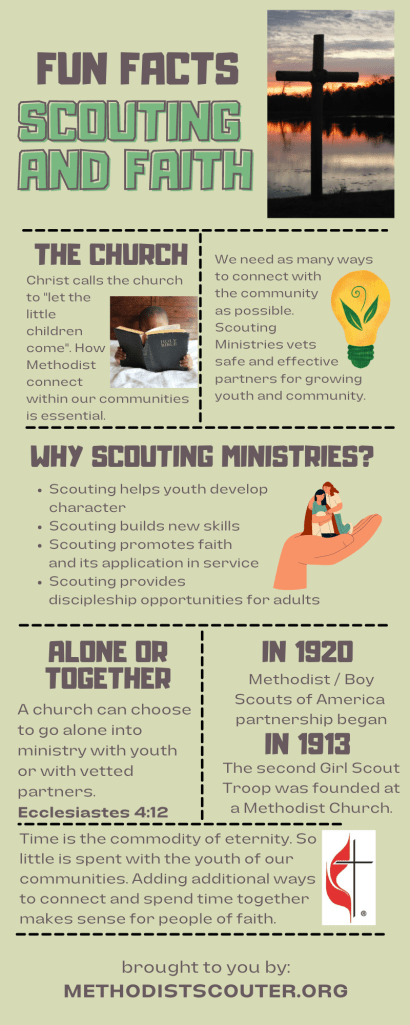
For the last 114 years, Methodists have sought to provide learning opportunities for youth through Scouting. Before the Boy Scouts of America was formed, some Methodist churches across the United States saw the value in living experiential lessons and the practical application of servant faith. They started Scout Troops. When BSA was formed, they joined.

Boy Scouts continued to pour resources and training into the volunteers who serve. Positions became more specific and structured. Two deep leadership, Youth Protection, Parents Guides(s) to Protecting Your Children From Child Abuse, and skills focussed training built high functioning, fun, and low problem groups. Safety increased rapidly and abuse descreased. These susccesses led to two unique outcomes. Many volunteers stayed with the Scouts long after their own children grew up. And BSA groups slid from the focus of most churches who supported Scouting before. BSA had served so well that the church did not see a need to provide focus on the youth and adults in Scouting.

The BSA bankruptcy changed the perception. 84,000 of claims of abuse were leveled at the BSA a majority pre-dating the 1974 CAPTA Act that addressed child abuse and neglect. The harm done needed to be recognized and justice served. Providing program for children and families to grow could only happen if the past taught the harsh lesson. The realization that the focus had shifted within churches became front and center. Many churches recognized the need to embrace ministry in community safely.

With the approval of the court to proceed with the restructuring, it is important for the church to stay in the safe agreements. It is also important that we live out our faith in community. Scouting is a perfect tool for time together. There is an expectation of Duty to God and Reverence. As BSA has made clear, the faith community should attend to the spiritual side. Our agreements commit the church to pray, hold Scout Sunday, and serve with Scouts. These are simple but fruitful ways we serve. It is important for the church to do for the least of these as Christ directed. Faith goes well beyond the legal agreements and into the eternal relationships.

Scout Sunday

Scout Sunday is one of the community’s most significant experiences of the modern church. It opens the door and shares worship. Many Scouts do not have a place of worship. We count them as our community. Family in ministry. Why not make sure they know we care and the doors are open next Sunday too?

TRUST

Trust

firm belief in the reliability, truth, ability, or strength of someone or something.
“relations have to be built on trust” – Oxford Languages Dictionary
  • Trust in God comes first
  • Trust in those who serve is required and diligence needed
  • Without trust, there is no Ministry
  • A Scout is Trustworthy, and So is Methodist Scouting

Trusting God can be difficult. Looking at the waters or the fire we are called to travel through brings natural fear. How can God prevail? People drown. People get burned. But God has done the miraculous so many times. God continues to bring us through. We must trust God first and walk down to the riverside. Hebrews 11:6 – “And without faith it is impossible to please him, for whoever would draw near to God must believe that he exists and that he rewards those who seek him.”

Trusting those who serve is important. God uses people for God’s will. Sometimes it is a direct path and others very indirect. These are all kinds of servants. Bishops, conference leaders, church leaders, and Scout leaders. The paths of thought may diverge but the desire for the good is the foundation. Not everyone has the same level of understanding. When you administer a large organization, the vision is different from the “walking with” that happens at the local level. Both are about caring. We need both. Trust requires diligence to watch each other’s back and know ours is being watched too.

Without trust, there is no ministry. Trust brings collaboration, innovation, and the invitation to the table. Without trust, we divide. Churches divide from each other and from century-old ministries which have blessed generations. Without trust, we hold to our own for fear of loss. When we trust, we hold to God knowing all is God’s to begin and end with. Trust makes needed changes into new ministry instead of abandonment.

Trustworthy is the first law of the Boy Scout Law. Honest and Fair are the first two commitments of the Girl Scout Law. We stand by these qualities and those who instill them in youth. Scouting is a trustworthy ministry. Methodist Scouting is Trustworthy. We have been at the table since the beginning. We have your back and will for the future.

“For surely I know the plans I have for you, says the Lord, plans for your welfare and not for harm, to give you a future with hope.” – Jeremiah 29:11

A Ministry for Christmas

עִמָּנוּאֵל Emmanouël or Εμμανουήλ Īmmānū’ēl Immanu El

Immanuel – God is with us.

Have you ever stopped to think deeply about the power of the statement made by an angel of the Lord to Joseph? The angel went back to scripture. The prophet Isaiah spoke of the sign and a name some 700 years before Jesus was to be born.

“Therefore the Lord himself will give you a sign. Look, the young woman is with child and shall bear a son, and shall name him Immanuel.” Isaiah 7:14 NRSV

God would take on earthly form that we might learn. Miracles were performed that we might see. Life was given that we might live. God is with us.

Where is God among us today?

If we are to be salt and light, the body of Christ, a living testimony, why are so many hungry? Why are we so fearful? Why do we hide from the challenge of ministry?

I encourage you to take time this Christmas season to find and live in ministry. Find a way to love as Jesus and live with others. Be, for a moment, a reflection of God that gives hope.

How about a ministry for Christmas? It requires us to be with others. God did it. God asks us to follow.

Merry Christmas!